

A maturity ladder for AI instruction setups, redrawn around the channel each rung runs on.
A few months ago I drew a maturity ladder for CLAUDE.md files — does the file exist, are constraints explicit, do skills load on demand. Useful for self-locating, and the ladder generalizes past Claude — CLAUDE.md, AGENTS.md, .cursorrules, Copilot instructions all live on the same rungs.
After a lot (lot lot lot) more time spent with these setups, the ladder is built on a different, broader axis than I first drew it on: the channel each rung runs on.
The new ladder
| Level | Name | What's added | Channel |
|---|---|---|---|
| L0 | System | System prompt only | attention |
| L1 | Primer | One instruction file (CLAUDE.md, AGENTS.md, .cursorrules) |
attention |
| L2 | Composite | Multiple files — user defaults, project overrides | attention |
| L3 | Scoped | Path-scoped rules (.claude/rules/*.md) |
attention |
| L4 | Delegated | Skills — procedures invoked on demand | attention |
| L5 | Abstracted | Sub-agents — child contexts called by the parent | attention (interface) |
| L6 | Governed | Hooks, MCP gates, deny-permissions | enforcement |
| L7 | Adaptive | Self-improving skills written by the agent | self-writing |
A quick tour
L0 (System) is the cold start: the model with whatever the vendor injected, nothing else.
L1 (Primer) is your single root file — the entry every model sees first.
L2 (Composite) is the moment you split user-level config from project-level: ~/.claude/CLAUDE.md vs ./CLAUDE.md, or your global Cursor settings vs a project .cursorrules.
L3 (Scoped) introduces path scoping — the rule about Python tests only loads when the agent touches tests/*.py.
L4 (Delegated) is skills, which let you ship procedures the agent can pull on demand instead of dumping every workflow into the root file.
L5 (Abstracted) is sub-agents — child processes with their own context, called by the parent for a focused subtask. The child's reasoning runs separately; what flows back into the parent is the result, which re-enters as a new source. The parent-child interface is on the soft channel; the child's internal work isn't.
L0 through L4 share one context — they all compete for the same finite slot against the user's prompt and the recent diff. L5 sits at the boundary: its coupling to the parent is soft, but the child's reasoning has its own context. That's the "soft" channel, broadly.
L6 (Governed) is where it profoundly changes. Hooks are not in the model's context window. A PreToolUse hook that blocks git push on a non-zero pytest exit doesn't get downweighted by a long task. An MCP server that requires authentication before reading a file doesn't depend on the model remembering your auth rule. Deny-permissions in .claude/settings.json for .env and .pem files don't compete with the rest of the spec. L6 is enforcement — outside the context dynamics, deterministic, not subject to load or context rot.
L7 (Adaptive) is different again. The agent writes its own instructions — not because the user said "remember this," but because the agent finished a task and decided some part of the trajectory was worth saving for next time. At read time the artifact lands in the attention channel like anything else. What's different is the writer: the model wrote the file, the trigger was task completion, and the user never saw the prompt that produced it. L7 is self-writing.
That's the ladder.
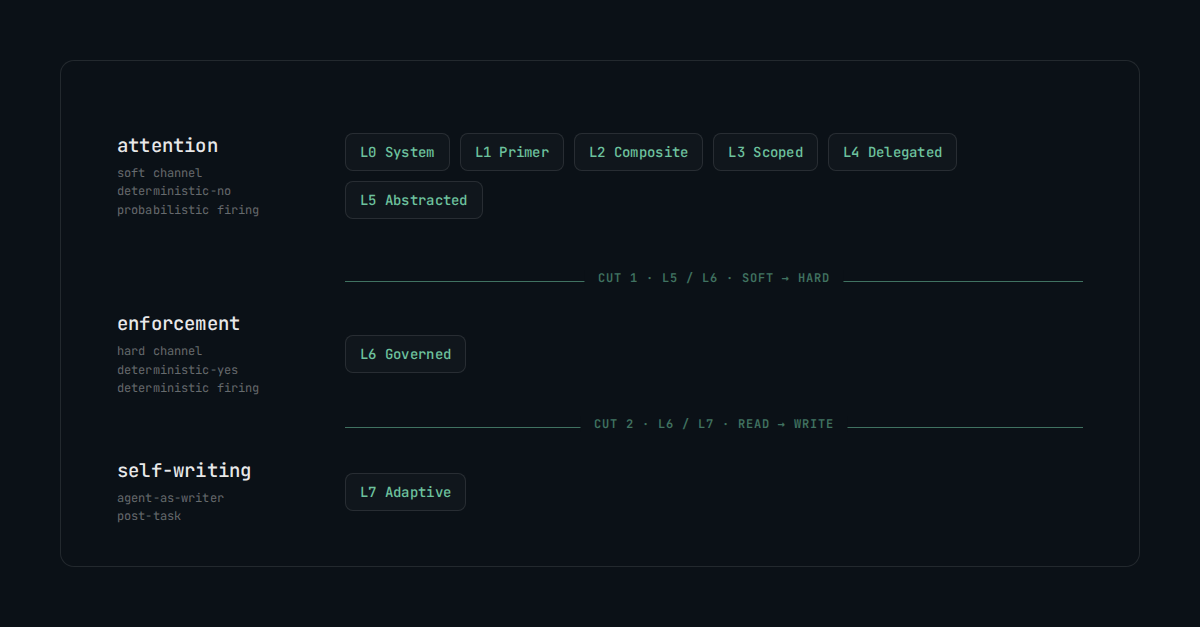
The first cut: L5 / L6
The load-bearing observation in this reframe is the cut between L5 and L6.
L0 through L5 all run on the attention channel — either directly on the parent's field (L0–L4) or on a child's that's coupled to the parent through prompts and results (L5). They compete. They decay with load. The model can downweight any of them, lose track of any of them, prioritize the user's prompt over any of them. You can tell a sub-agent "always check tests before reporting done" and it'll do it 80% of the time, or 95%, or 60% — you don't know without measurement. The same instruction in a CLAUDE.md and the same instruction passed to a sub-agent are running on the same physics, just on different fields.
L6 is outside that physics entirely.
Worked example. Suppose your CLAUDE.md says "never push without running tests." That's L1. The model reads it, integrates it into context, weights it against everything else loaded — your other rules, the recent diff, the user's prompt. If you have four thousand tokens of instructions and the model is mid-task, that line is competing with everything else for attention. Sometimes it follows. Sometimes it doesn't.
Now suppose you have a PreToolUse hook on Bash that exits non-zero if pytest fails. That's L6. The model can decide to push or not push. It doesn't matter. The push fails before the model's intent reaches the network.
Same constraint, two channels, two failure modes. Soft channel fails probabilistically. Hard channel fails deterministically. They take different fixes — soft constraints want better content and ordering (the Pink Elephant piece is about that fight), hard constraints want a better hook script or a tighter permission rule.
Calling these the same thing because they're both "in your .claude/ directory" hides the architectural difference.
The second cut: L7 writes itself
L7 isn't a third channel exactly — at read time, what L7 wrote lands in the same context with everything else. The cut is at write time. The agent writes its own instructions.
Most "memory" features in shipping agents aren't L7 by this cut. Claude Code's saved memory writes when the user signals remember this or accepts a prompt to save. Cursor's notepads, Copilot's pinned context, Gemini's saved facts — same pattern. The agent keeps the artifact, but the user authored it. That's persistent context, not self-writing. Call it L6.5 if you want a name for it.
The clearest L7 in print today is Hermes Agent, released by Nous Research in February. When a Hermes task runs five or more tool calls, a background process summarizes the trajectory into a markdown skill file with a YAML frontmatter header. Future sessions load it. The user didn't ask for the skill. The agent decided the task was structured enough to extract one. The next time a similar problem surfaces, the skill loads automatically. That's the cut: the writer is the agent, the trigger is task completion, the artifact is a reusable rule.
The new failure mode is the self-writing layer running unsupervised. An auto-generated skill that overfits to one project. A trajectory summary written under a stale assumption that surfaces six weeks later as a phantom instruction. There's no rule file the user authored to grep for the source — the rule is in a markdown file the agent wrote and the user never read.
L7 doesn't replace L0–L6. It runs alongside, with its own writes and its own decay. Most agent setups don't have it because most agents don't expose it. The ones that ship a memory feature mostly do L6.5 and call it L7.
When to climb
The dominant pattern I see in real repos is L1 with a thin L6: a CLAUDE.md, maybe a few rule files at L3, deny-permissions for .env. L4 (skills) is rare — most authors haven't built any. L5 (sub-agents) is rarer — most use cases haven't surfaced. L7 is mostly absent — most agents don't expose a self-writing surface, and the few setups that do have one running treat it as opt-in defaults nobody reviewed.
Across 28,721 public repositories with AI configs, 89.9% don't name specific constructs in their instructions — no backticks, no file paths, no function names. That's most of the soft channel running at low coupling: easily downweighted, easily lost. The hard channel is thinner. The adaptive channel is mostly absent.
Large spec, small contract, no adaptive layer. That's the asymmetry — but it's not always a bug. Each rung exists because the rung below it fails in a specific way. The trigger is the failure, not a feature wishlist.
| From | To | Symptom that triggers the climb |
|---|---|---|
| L0 | L1 | Re-explaining the same project context every session |
| L1 | L2 | One file got long enough that important rules get ignored |
| L2 | L3 | Path-irrelevant rules pollute every task |
| L3 | L4 | The same procedure gets described inline across multiple rules |
| L4 | L5 | A procedure pollutes the parent's context with reasoning chains the parent doesn't need |
| L5 | L6 | A constraint must hold 100% of the time, not 95% |
| L6 | L7 | You keep correcting the same preference across sessions |
The mistake is climbing without the symptom. A repo with three rules in one file doesn't need L3. A solo developer's CLAUDE.md doesn't need a sub-agent. Premature climbs cost context budget for no return; you've added structure the model has to navigate without solving a problem you actually had.
The opposite mistake is more common: under-building the higher rungs because the symptoms feel like model failures rather than rung failures. "The agent didn't run tests before pushing" reads like a prompt-engineering problem; it's a missing L6. "The agent forgot we use Cloudflare Workers" reads like context drift; it's a missing L7. "The agent keeps describing the deploy process every time I ask" reads like verbosity; it's a missing L4.
Climb when the rung below stops working.
Three questions for your repo
Not a recipe. A diagnostic. For any rule in your setup, ask:
- Does this fail loudly when violated, or silently? Loudly is L6. Silently is L0–L5.
- Does the model see this, or does the runtime enforce it? Sees is the soft channel. Runtime is the hard channel.
- Does it get worse when you add unrelated rules to the same file? Yes is L0–L5. No is L6. "Sometimes" is probably L7.
Most rules answer silently / sees / yes. That tells you which channel you're in. The interesting question is whether anything in your setup is on the other channels at all.
A note on related taxonomies
There are other progressive ladders for AI agent setups in print. Vellum's L0–L5 is an autonomy axis — how much the agent decides on its own. Blake Crosley's 4-tier is a concurrent-decomposition axis — how many agents run in parallel. Anthropic's 5-layer ADK frame for Claude Code is a content-boundary axis — what kind of content goes where. Zylon's 5-architectural and GitHub's 3-tier carve different cuts again, mostly around how the agent is wired into a product surface.
The ladder above is on a different axis from any of those. It sorts by the channel each mechanism runs on — soft attention, hard enforcement, self-writing memory — and progresses through the named constructs an agent exposes (CLAUDE.md, scoped rule files, skills, sub-agents, hooks, auto-memory). The two cuts (L5/L6 and L6/L7) are the load-bearing claim; the autonomy and concurrency taxonomies don't draw those cuts because they're sorting on different things.
Different axis, different cuts, different diagnostic. Use whichever maps onto the question you're actually asking.
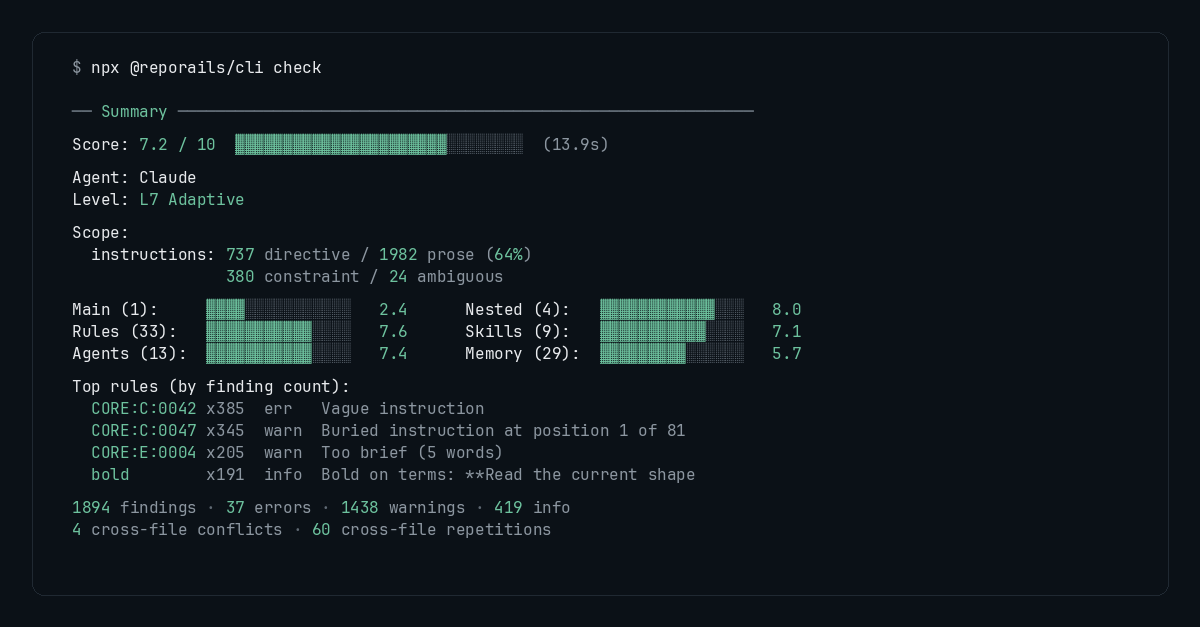
Previously: CLAUDE.md Best Practices: From Basic to Adaptive — where I drew the ladder the first way. I'm building Reporails, measurement for the attention channel. npx @reporails/cli check runs locally, no account needed.